How to Pack a Kitchen So Nothing Breaks
The kitchen is the room where the most things break, and a simple order of work keeps almost all of it in one piece.
October 21, 2026 · 4 min read
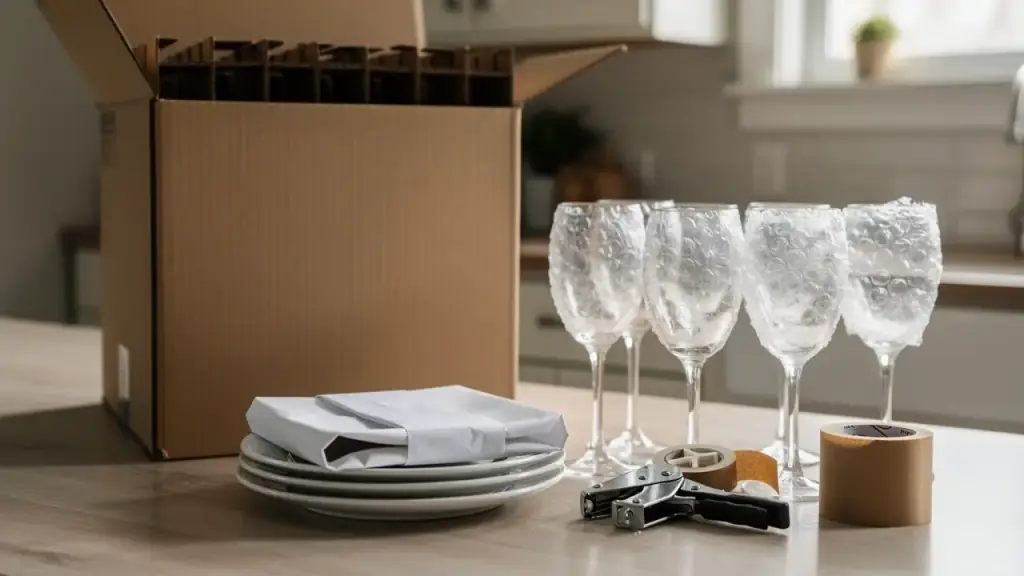
The kitchen is the room that takes longest to pack and the one where the most things break. It's full of glass, ceramic and sharp edges, and almost nothing has the same shape as the thing next to it. A Fremont household with a full set of dishes, a few years of gadgets and a junk drawer nobody has opened lately can easily need most of a day for this room alone. The good news is that kitchens reward a plan. Pack in the right order, use the right boxes, keep the heavy things low, and your dishes will arrive in one piece.
Start earlier than feels necessary
Begin about two weeks out with the things you use least. The fondue pot, the cake stand, the extra wine glasses and the waffle iron can all go in a box now without changing how you cook. Keep one pot, one pan, a few plates, cutlery and a couple of mugs out. That's your working kitchen until the last night. Pack in stages and the final evening becomes a short job instead of a panic. It's also a fair moment to ask what you actually use. If an appliance hasn't been touched in a year, it doesn't need a seat on the truck.
Get the right boxes and paper
Ordinary cardboard boxes are fine for pots and pans, but dishes and glasses travel better in dish packs, which are sturdy double-walled boxes, often with cell dividers for glasses. Get enough before you start. Running out halfway through is how plates end up in a laundry basket. Use plain packing paper, not newspaper. Newsprint ink rubs off on white plates and leaves gray smudges on glassware that you'll be scrubbing at the new place.
Tape the bottom of every box along the seam and then add a strip each way, so the weight rides on tape and not on the flaps. Put a few sheets of crumpled paper in the bottom as a cushion before anything goes in.
Plates, bowls and glasses
Plates go in on edge, never flat. A flat stack puts the full weight of everything above on the bottom plate, while a plate standing on edge is far harder to crack. Wrap two or three together in a bundle of paper, then stand the bundles side by side like records in a crate, with crumpled paper in every gap. Bowls can nest in pairs with paper between them and go in the same way.
Glasses are the fragile ones. Stuff a loose wad of paper inside each glass, then wrap the outside and twist the ends. Stemware needs extra attention around the stem and rim, so wrap that part twice. Put glasses in the top layer of the box, never the bottom, and never nest them inside one another. Give the closed box a gentle shake. If you hear anything sliding or clinking, open it and add more paper.
Inside a dish pack, the order matters:
- Heaviest pieces on the bottom, such as platters, cast iron and large bowls.
- Plates and mid-weight pieces in the middle, standing on edge.
- Glasses and stemware on top, with extra padding.
- A last layer of crumpled paper so the lid presses down lightly and nothing more.
Pots, pans, knives and small appliances
Pots and pans can nest, with a sheet of paper between each so the finishes don't scratch. Bundle lids separately. Knives need real protection. Wrap each blade in a fold of cardboard or a dish towel, tape it shut, and mark the bundle so nobody reaches in bare-handed at the other end. Small appliances go back in their original boxes if you kept them. If not, wrap the cord around the body, pad the box well, and write a note on the outside if a glass pot or blender jug is inside.
Weight, labels and the first night
Kitchen boxes get heavy fast. A small box of canned goods or cookbooks can strain a back, so keep dense items in small boxes and light ones in bigger boxes. If you can't lift it comfortably, it's too heavy. Label every box on the side, not the top, since boxes get stacked. Write the room, a short description such as 'dishes, fragile' and an arrow pointing up. Mark the last box you pack, the one with everyday plates, the coffee maker and a roll of paper towels, as 'open first'.
Empty the fridge and freezer a day or two ahead, and seal any open bottles of oil or sauce in a bag. A spill inside a kitchen box is a miserable thing to find at the other end.
If you'd rather have a hand with the heavy lifting, or you want someone else to pack the kitchen, call Bharat Mover at 408 502 2677 and ask for a free estimate. Packaging is one of the services they list, so it's a fair question to ask.
Bharat Mover, 408 502 2677
Call 408 502 2677More articles
Moving a Piano or an Antique Without Damage
Heavy and delicate pieces are won or lost in the preparation, long before anyone lifts.
A Week-by-Week Moving Checklist for Fremont and the East Bay
Six weeks, one folder and a first-night box turn a chaotic move into a list you can finish.